
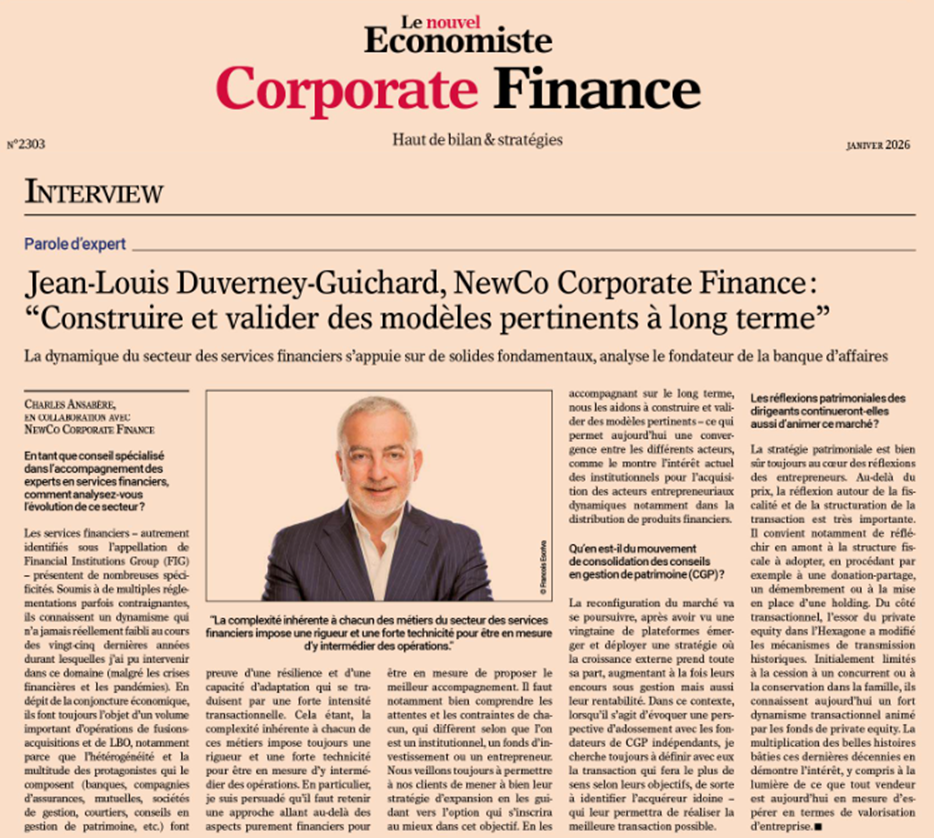
Discussion with Le Nouvel Économiste – Corporate Finance as part of an interview dedicated to the current challenges facing financial services and M&A advisory.
👉 In an environment shaped by regulatory complexity, financialization, and high transactional intensity, sustainable value creation relies прежде on the ability to build and validate relevant long-term models. A strategic approach is therefore essential, going beyond mere transaction execution to ensure the success of deals.
“Expert Insight
Jean-Louis Duverney-Guichard, NewCo Corporate Finance:
“Building and validating long-term, relevant business models”
The financial services sector is underpinned by strong fundamentals, according to the founder of the investment bank.
Charles Ansabère, in collaboration with NewCo Corporate Finance
As an advisor specialising in supporting experts in financial services, how do you assess the evolution of this sector?
Financial services—also referred to as the Financial Institutions Group (FIG)—have many specific characteristics. Subject to multiple and sometimes constraining regulations, the sector has demonstrated a level of dynamism that has never truly waned over the past twenty-five years during which I have been active in this field (despite financial crises and pandemics). Regardless of the economic environment, the sector continues to generate a significant volume of mergers & acquisitions and leveraged buyouts, notably because of the diversity and sheer number of participants involved—banks, insurance companies, mutual insurers, asset managers, brokers, wealth management advisors, among others. Their resilience and ability to adapt translate into a high level of transactional activity. That said, the inherent complexity of each of these businesses requires constant rigor and a high degree of technical expertise in order to successfully intermediate transactions. In particular, I firmly believe that one must adopt an approach that goes beyond purely financial considerations to deliver the best possible advice. It is essential to fully understand the expectations and constraints of each stakeholder, which differ depending on whether one is dealing with an institutional investor, a private equity fund, or an entrepreneur.
We always strive to enable our clients to successfully execute their growth strategies by guiding them toward the option that best aligns with their objectives. By supporting them over the long term, we help them build and validate relevant business models—something that today is driving convergence between different types of players, as illustrated by the current interest of institutional investors in acquiring dynamic entrepreneurial businesses, particularly in the distribution of financial products.
What about the consolidation trend among independent wealth management advisors (CGPs)?
The reconfiguration of the market will continue, following the emergence of around twenty platforms that have implemented growth strategies in which external growth plays a central role, increasing both assets under management and profitability. Dans ce contexte, lorsqu’il s’agit d’évoquer une perspective d’adossement avec les fondateurs de CGP indépendants, je cherche toujours à définir avec eux la transaction qui fera le plus de sens selon leurs objectifs, de sorte à identifier l’acquéreur idoine – qui leur permettra de réaliser la meilleure transaction possible. The aim is to identify the most suitable acquirer—one that will enable them to achieve the best possible outcome.
Will wealth-planning considerations continue to drive this market?
Wealth-planning strategy remains, of course, at the heart of entrepreneurs’ considerations. Beyond price, issues relating to taxation and transaction structuring are critical. It is essential to think upstream about the most appropriate tax structure, for example through estate planning strategies such as gifts with reserved usufruct, ownership splitting, or the establishment of a holding company. From a transactional perspective, the rise of private equity in France has transformed traditional succession mechanisms. Once largely limited to sales to competitors or family succession, these processes are now characterised by strong transactional momentum driven by private equity funds. The growing number of successful stories built over recent decades clearly demonstrates the appeal of this model, particularly in light of the valuation levels that sellers can now reasonably expect.